Top 7 Signs Your Business Needs Custom Software Instead of SaaS
Most businesses start with SaaS, and for a while, it works perfectly. Affordable, ready on day one, no developers needed. But somewhere between 15 employees and 150, something quietly breaks. Workflows get messier. Subscription bills compound. Your team starts copying and pasting across five different tools. And your competitive edge, the thing that makes your operations different, gets buried inside a product built for everyone except you.
This guide is for business owners and operators in the US who are past the "should I use software" stage and are now asking the harder question: should we keep paying for SaaS tools that almost fit, or build something that fits exactly?
There is no single right answer. But there are clear signals. Here are the seven most reliable ones.
$374B
Global SaaS market size projected by 2026
22.6%
Annual growth rate of custom software development globally
55%
Average ROI reported by businesses using custom software over 5 years (Gartner)
What Is SaaS?
SaaS - Software as a Service is pre built cloud software you access via subscription. Think Salesforce, HubSpot, Slack, QuickBooks, or Shopify. The vendor builds it, hosts it, updates it, and sets the roadmap. You configure it within the boundaries they allow and pay monthly or annually per user or usage tier.
SaaS is genuinely excellent for standard business operations. It eliminates infrastructure headaches, ships updates automatically, and gets you from zero to functional in hours, not months. For early-stage startups or businesses with common operational needs, it is often the smartest starting point.
What Is Custom Software?
Custom software is software built specifically around your business your workflows, your data model, your users, and your growth roadmap. You own the code, the architecture, and the intellectual property. No per-seat pricing. No vendor decides which features to sunset. No competing with 50,000 other companies for priority on the product roadmap.
Custom software development means building from the ground up or significantly extending existing systems — so that the technology fits your operation, not the other way around.
Custom Software vs SaaS: A Direct Comparison
| Factor | SaaS | Custom Software |
|---|---|---|
| Initial Cost | Low (subscription) | Higher upfront investment |
| Time to Deploy | Hours to days | Weeks to months |
| Workflow Fit | Built for general use | Built for your exact process |
| Scalability Cost | Per-seat pricing compounds | Scales on your infrastructure |
| Data Ownership | Stored on vendor servers | You own everything |
| Integration Control | Limited by vendor APIs | Full integration flexibility |
| Long-Term ROI | Predictable but accumulates | Strong ROI past year 2–3 |
| Feature Control | Vendor decides roadmap | You control every feature |
| Vendor Lock-in Risk | High | None |
| Security Compliance | Vendor-defined policies | Fully configurable (HIPAA, SOC 2, etc.) |
7 Signs Your Business Needs Custom Software
These are not hypothetical scenarios. These are the patterns we see most often when US businesses come to us after years of fighting their SaaS tools. If three or more of these sound familiar, it is worth having a serious conversation about building your own platform.
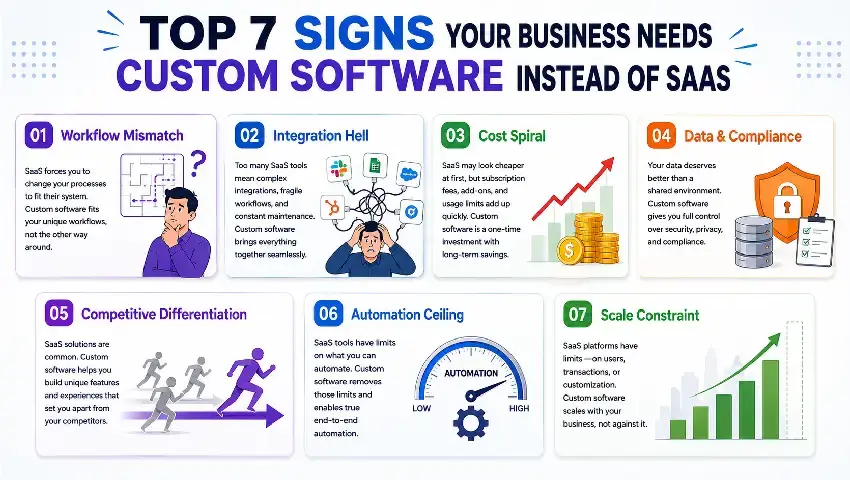
01 Workflow Mismatch
SaaS Can't Support How Your Business Actually Operates
Every SaaS product is built for a hypothetical average user not for you specifically. When your actual workflows require workarounds, hacks, or "we just do it manually" exceptions, that is the software telling you it was not designed for your business.
A regional logistics company we spoke with had three operations staff spending two hours a day manually exporting data from their shipping SaaS, reformatting it in Excel, and re-importing it into their billing tool. That is 120 hours a month roughly $4,800 in labor being spent on a problem that custom middleware or a unified platform would solve permanently. If your team is consistently working around your software, the software is the problem.
02 Integration Hell
Your Integrations Are Fragile, Expensive, or Simply Don't Exist
SaaS tools talk to each other through APIs and those APIs have limits. Rate limits. Webhook failures. Third-party connectors like Zapier that break when a vendor updates their endpoint. Functionality that exists in one tool but cannot be accessed by another because the integration is not on the vendor's priority list.
If you find yourself paying for Zapier, Make, or a custom API middleware just to keep your SaaS stack communicating, you are already paying for the complexity of custom development without the reliability, ownership, or flexibility that comes with it. Custom software built with a unified data layer eliminates this fragility entirely.
03 Cost Spiral
Your Monthly SaaS Bill Keeps Growing Without Matching Growth in Value
SaaS pricing is designed to scale with your growth which sounds reasonable until you realize what that means in practice. More users means more seats. More data means a higher storage tier. More features means a premium plan. Every milestone in your business triggers another billing tier increase from multiple vendors simultaneously.
Research shows that total SaaS spending over five years typically exceeds the equivalent custom development cost significantly particularly for teams above 25 users running three or more core business tools. If you are paying $8,000–$20,000 per month across your software stack and that number grows every quarter, a one-time custom build deserves serious financial modeling.
A business should consider custom software when existing SaaS tools cannot support operational workflows, scalability, integrations, security, or automation requirements. If your team is working around your software rather than with it, that is a clear signal.
Qubitron Labs — Software Architecture Guideline
04 Data & Compliance
Your Data Has Compliance, Security, or Sovereignty Requirements
With SaaS, your data lives on the vendor's infrastructure, subject to their terms, their security architecture, and their business continuity decisions. For most consumer businesses, this is acceptable. For healthcare (HIPAA), financial services, legal firms, government contractors, or any business handling sensitive client data, this is a real risk.
Regulated industries in the US are increasingly running into situations where a vendor's compliance certifications SOC 2, ISO 27001 do not fully satisfy their specific requirements or their clients' contracts. Custom software built to your security posture gives you complete control over data residency, access policies, audit logs, and encryption standards. You are not dependent on a vendor's compliance team to protect your clients.
05 Competitive Differentiation
Your Unique Process Is Your Competitive Advantage And SaaS Erases It
When every business in your industry uses the same SaaS CRM, the same project management tool, the same eCommerce platform you are all operating off the same playbook. The features your competitors have access to are the same features you have access to. The ceiling is the same.
If your competitive advantage lives in how you serve clients, how you manage operations, or how your team communicates and that process can be encoded into software custom development is a moat. It is a capability your competitors cannot simply license. Many mid market businesses in the US that have built genuine defensibility against larger competitors have done so by turning operational excellence into proprietary tooling.
06 Automation Ceiling
You're Doing Manual Work That Should Be Automated But SaaS Won't Let You
Workflow automation inside SaaS platforms is powerful up to a point. That point is determined by the vendor, not by you. The automations you can build are constrained by what triggers, actions, and conditions the vendor chose to expose. Anything outside those parameters requires a human doing it manually.
Custom software development removes that ceiling. Every repetitive process in your operation approvals, notifications, data transformations, reporting, scheduling, client communication can be fully automated when the software is yours. For businesses where operations staff are running the same manual sequences daily, automation ROI from a custom build often recovers the entire development cost within 12 to 18 months.
07 Scale Constraint
Your Current Software Cannot Scale to Where You're Going
SaaS platforms are built for broad market use, not for the specific growth trajectory of your business. As transaction volume increases, as your team expands internationally, as your product line diversifies the SaaS tools that worked at $1M ARR often begin to show structural cracks at $10M or $20M.
Performance degrades. Reporting becomes inadequate. The data model the vendor chose does not accommodate your evolved business logic. Migrating to a higher-tier SaaS product means renegotiating contracts, retraining staff, and rebuilding integrations. Custom software, built with scalability baked into the architecture from the start, grows alongside you on your terms, without renegotiation.
Quick Decision Framework
Build Custom Software When
- Your workflows are unique to your business
- SaaS subscription costs are compounding fast
- Integrations are fragile or non existent
- You handle regulated or sensitive data
- Your process is a competitive differentiator
- You need automations SaaS won't allow
- You're planning serious scale in 12–24 months
Stick with SaaS When
- You're validating a business idea
- Your needs are standard and well served
- You need to be operational within days
- Team size is small and costs are controlled
- No specialized compliance requirements
- Your process mirrors what SaaS already does
- Budget is not yet available for development
When SaaS Is Still the Right Choice
Being honest about this matters. Custom software is not the answer for every business, and recommending it when it is not the right fit is just bad advice.
If you are an early-stage startup still validating your market, SaaS is almost always the right tool. You need speed, not perfection. HubSpot, Notion, Stripe, and Jira can support a business to $1M ARR and beyond without any custom development. The goal at that stage is to learn fast, not to build infrastructure.
Similarly, if your operational needs are genuinely standard you need payroll, project tracking, or basic CRM functionality a well established SaaS product will do the job better and cheaper than anything custom-built. Not every business has workflows that justify a bespoke build. The test is simple: if an off-the-shelf tool handles 95% of your needs without requiring significant workarounds, that tool is probably the right choice.
Final Thoughts
The shift from SaaS to custom software is rarely a sudden decision. It is usually the result of months sometimes years of accumulating friction. Another workaround. Another integration that breaks on a Friday afternoon. Another renewal where the bill went up and the functionality did not.
If you recognize three or more of the seven signs above in your business today, it is worth getting an honest technical assessment. Not a sales pitch an actual analysis of your current stack, your workflows, and what a custom build would cost versus what you are currently spending and losing in productivity.
The businesses we work with at Qubitron Labs are not looking for the cheapest option. They are looking for the right one. Sometimes that is optimizing what they already have. Sometimes it is a phased custom build that starts with the most painful bottleneck. Sometimes it is a complete platform rebuild. The starting point is always an honest conversation about where the real cost is sitting.
Not Sure Which Path Is Right for You?
We'll audit your current software stack, map your workflows, and give you a clear recommendation no sales pitch, no obligation.
Book a Free Architecture Consultation See Our Services →
© 2026 Qubitron Labs · Jaipur, India · Serving clients across the United States · qubitronlabs.com