Blockchain Framework Guide for Enterprises | Qubitron Labs
Enterprises are now investing a lot in blockchain technology because it is no longer just a trend. It is becoming a real tool for business growth. The global blockchain market is expected to grow from about $33 billion to more than $390 billion by 2030. This shows that many industries are starting to use blockchain in new and innovative ways.
However, even with this fast growth, many blockchain projects fail because they do not have a strong base. This is where blockchain development frameworks help. These frameworks offer ready-made tools for things like smart contracts, identity management, consensus systems, and system integration. Because of this, developers can build secure, scalable, and reliable blockchain applications faster and more easily.
This guide explains the best blockchain frameworks, compares them, and shows practical steps to help developers, business leaders, and tech learners make smart decisions.
What Is a Blockchain Development Framework?
A blockchain development framework is a basic structure that helps developers create, run, and manage blockchain applications. It includes important parts like consensus systems, smart contracts, network rules, identity tools, and APIs. Instead of building everything from scratch, teams use frameworks to save time and reduce risks.
Many people think blockchain frameworks and blockchain platforms are the same, but they are different. A blockchain platform is the main network, such as Ethereum or Solana. A framework focuses on how applications are built and managed on that network. For enterprises, frameworks are very useful because they offer better control, scalability, and security, which are important for real business use.
When comparing a blockchain framework with a blockchain platform, the main difference is control and purpose. If you need customization, permission settings, and enterprise-level management, frameworks become much more important.
Leading Blockchain Development Frameworks for Enterprise and Web3 Applications
Blockchain technology is growing very fast, and choosing the right framework can make a big difference in your project. Some frameworks are best for enterprise systems, some for NFTs, some for payments, and others for cross-chain applications.
If you want to start a blockchain project, it is important to understand what each framework offers. Below is a simple guide to the top blockchain development frameworks.
Ethereum
Ethereum is one of the most widely used blockchain platforms for smart contracts and public applications. It uses the Ethereum Virtual Machine (EVM), which allows developers to create smart contracts using the Solidity programming language. These smart contracts run automatically on the blockchain.
Ethereum also provides many useful tools, such as Truffle, Hardhat, and Foundry. These tools help developers test, deploy, and manage decentralized applications more easily. Because of its large ecosystem and strong developer community, Ethereum is commonly used for NFTs, DeFi platforms, DAOs, token projects, and user-focused applications.
Ethereum has improved its performance with Layer-2 solutions like rollups, which help reduce transaction fees while maintaining security. Many enterprises use Ethereum for permission-based networks, digital assets, and privacy-focused solutions using zero-knowledge proofs. However, developers still need to manage gas fees carefully and follow secure coding practices to avoid risks and unexpected costs.
Polygon
Polygon is a Layer-2 blockchain framework built on Ethereum. Its main goal is to make transactions faster and cheaper. Since Polygon is fully compatible with the Ethereum Virtual Machine (EVM), developers can use Solidity and familiar tools like Hardhat, Truffle, and MetaMask without learning new systems.
Polygon offers multiple scaling solutions, such as sidechains, zk-rollups, and optimistic rollups. Because of this, many Ethereum applications can move to Polygon with only small changes in their code. This makes Polygon a popular choice for developers who want better performance while staying connected to the Ethereum ecosystem.
Solana
Solana is a high-speed blockchain designed for fast and low-cost transactions. It uses a special system that combines Proof of History (PoH) and Proof of Stake (PoS) to process a large number of transactions quickly. Most smart contracts on Solana are written in Rust, which offers strong performance but can be harder for beginners to learn.
Solana can handle thousands of transactions per second with very low fees. It is widely used for DeFi platforms, NFT marketplaces, blockchain games, and real-time applications. Projects that need high speed, such as trading platforms and on-chain games, often choose Solana. However, Solana has faced some network issues in the past, so developers should also think about stability when choosing it. Even so, it remains a strong option for performance-focused projects.
Cardano
Cardano is a blockchain platform built with a strong focus on security, scalability, and long-term sustainability. It uses an energy-efficient Proof of Stake system called Ouroboros. Smart contracts on Cardano are written in Plutus, a language based on Haskell, which is more suitable for developers familiar with functional programming.
Cardano follows a research-first approach, where updates are carefully tested and reviewed before release. It is commonly used for enterprise solutions, academic projects, and applications that require high security and accuracy. Cardano is also used in government and digital identity projects in some regions. Although development on Cardano can be slower compared to other blockchains, its strong focus on reliability makes it ideal for projects where security is more important than speed.
Binance Smart Chain (BNB Smart Chain)
Binance Smart Chain, also called BNB Smart Chain, is an EVM-compatible blockchain created by Binance. Developers can use Solidity and Ethereum tools to build applications easily on this network. It uses a Proof of Staked Authority (PoSA) system, which helps process transactions faster and keeps fees low. Because of this, BSC is suitable for projects that need quick setup and high transaction volume.
BSC is widely used for DeFi platforms, token projects, yield farming applications, and NFT marketplaces. Many startups prefer it because it is affordable and connected to the Binance ecosystem. However, BSC is more centralized than Ethereum, which some developers consider a disadvantage. Even so, it remains a practical choice for building fast and low-cost blockchain applications.
Polkadot
Polkadot is a multi-chain framework that helps different blockchains communicate with each other. It uses a relay chain and parachains, which allow multiple blockchains to work together at the same time. Developers build on Polkadot using Substrate, a powerful tool for creating custom blockchains. This design improves scalability and interoperability.
Polkadot is commonly used for cross-chain DeFi projects, connected blockchain networks, and complex Web3 systems. It is especially useful for projects that require interaction between multiple blockchains. Compared to EVM-based chains, Polkadot has a steeper learning curve, especially when working with Substrate. However, once mastered, it offers high flexibility and scalability.
Hyperledger Fabric
Hyperledger Fabric is a permission-based blockchain framework designed mainly for enterprise use. It allows organizations to create private blockchain networks where all participants are verified. Fabric supports smart contracts, called chaincode, which can be written in languages like Go, Java, and Node.js. Its modular design lets companies customize consensus methods, identity systems, and privacy features.
Hyperledger Fabric is widely used in supply chain, finance, healthcare, and logistics. It is ideal for business-to-business applications where data privacy and access control are important. Unlike public blockchains, it is not designed for open dApps or token-based projects. To ensure stable performance, proper planning and configuration are essential.
Casper Network
Casper Network is a Proof of Stake blockchain built to be developer-friendly and easy to upgrade. It uses WebAssembly (WASM) for smart contracts, which allows developers to write code in different programming languages. Casper focuses on stable gas fees and scalability, making it easier to plan long-term blockchain projects. It also allows smart contracts to be updated without breaking the system.
Casper is used for enterprise blockchain solutions, DeFi platforms, and applications that need flexibility over time. Its energy-efficient design makes it suitable for eco-friendly projects. Since the ecosystem is still growing, its tools are not as advanced as Ethereum’s. However, Casper is a good choice for developers who want more control and future-ready smart contracts.
Quorum
Quorum is an enterprise-focused blockchain framework built on Ethereum. It supports private transactions and permission-based networks while staying compatible with Ethereum. Developers can use Solidity and Ethereum tools, which make it easy for teams already familiar with Ethereum to adopt Quorum. It also offers faster transaction processing than public Ethereum.
Quorum is mainly used by banks, financial institutions, and large enterprises to build secure blockchain solutions. Because it is permission-based, it is less decentralized than public blockchains. Still, for enterprise-level systems that need privacy and control, Quorum is a strong and reliable option.
Stellar
Stellar is a blockchain network designed for fast payments and digital asset transfers. It uses the Stellar Consensus Protocol (SCP), which enables quick and low-cost transactions. Developers can build applications using Stellar tools and create custom digital assets on the network. Stellar is optimized for speed and simplicity rather than complex smart contracts.
Stellar is widely used for cross-border payments, remittances, stablecoins, and fintech applications. Many financial institutions and startups use it to transfer money across borders efficiently. It is not ideal for complex dApps or DeFi platforms. However, for payment-focused blockchain solutions, Stellar performs very well.
Enterprise Comparison of Blockchain Development Frameworks
Choosing the right blockchain framework can be confusing because there are many options available. A simple comparison makes it easier for enterprises and developers to understand which framework fits their needs. Below is an easy side-by-side overview of popular blockchain frameworks.
Quick Comparison of Top Blockchain Frameworks
| Framework | Type | Network | Scalability | Smart Contracts | Best For |
|---|---|---|---|---|---|
| Ethereum | Platform | Public | Medium | Solidity | dApps, DeFi |
| Polygon | Layer-2 | Public | High | Solidity | Scalable Ethereum apps |
| Solana | Platform | Public | Very High | Rust | High-speed dApps |
| Hyperledger Fabric | Framework | Private | High | Go, Java, JS | Enterprise systems |
| Quorum | Enterprise Ethereum | Private | High | Solidity | Financial institutions |
| Hedera Hashgraph | DLT | Public / Private | Very High | Solidity | Enterprise-grade solutions |
| Polkadot | Protocol | Public | High | Rust | Cross-chain applications |
| Stellar | Platform | Public | Medium | Limited | Payments and remittances |
| Casper Network | Platform | Public | Medium | Rust | Enterprise adoption |
Every blockchain framework is created to solve different problems. Some focus on speed and low transaction fees, while others focus on privacy, governance, or enterprise requirements. By understanding these differences, businesses can choose a framework that matches their technical needs, business goals, and long-term growth plans.
How Enterprises Should Evaluate Blockchain Development Frameworks
Choosing the right blockchain development framework is not only a technical choice but also a business decision. The framework you select will impact security, scalability, compliance, and how easily your system can grow in the future. Instead of following trends, enterprises should focus on frameworks that truly match their goals and risk level.
Key Factors to Consider
When comparing blockchain frameworks, enterprises should first look at these important points:
Security and Consensus Mechanism:- Understand how the network confirms transactions and protects data. Some companies prefer well-tested and stable systems, while others may choose faster solutions with certain trade-offs.
Scalability and Performance:- Check how many transactions the network can handle and how fast it responds. A framework that works well in testing may face problems when used at a large scale.
Privacy and Access Control:- Many industries need strict control over who can view or use data. In such cases, permission-based or private blockchain frameworks are often more suitable.
Smart Contract Flexibility:- The framework should allow the level of customization your project needs without making development too complex or risky.
Community and Long-Term Support:- A strong developer community, clear documentation, and reliable long-term support can make development and maintenance much easier over time.
Public vs Private Blockchain Frameworks
Not every business needs the same type of blockchain. Some projects require open networks, while others need more control and privacy. The right choice depends on how open the system should be and who will use it.
Types of Blockchain Frameworks
| Framework Type | Best Used For | Main Features |
|---|---|---|
| Public | Open platforms, DeFi, public apps | High transparency, strong decentralization, limited privacy |
| Private | Internal enterprise systems | Controlled access, better performance, easier compliance |
| Consortium | Industry partnerships, shared networks | Shared control, selective transparency, trusted participants |
Public blockchain frameworks are best for open and decentralized systems. Private frameworks are better for internal business operations where data control is important. Consortium frameworks fall between public and private models and are often used in industries like supply chain and banking.
If you want to understand more, you can explore the differences between public and private blockchains or learn how enterprises build private blockchain systems for real-world use cases.
Use Cases of Blockchain Development Frameworks
Blockchain development frameworks help organizations build, manage, and grow blockchain solutions in a structured way. Instead of creating everything from scratch, enterprises use these frameworks to solve real business problems securely and reliably.
Finance and Payments
In the finance sector, blockchain frameworks are used to create secure payment systems, settlement platforms, and digital asset solutions. Banks often use enterprise frameworks to build permission-based networks for cross-border payments. These frameworks clearly define rules, access levels, and audit processes, helping businesses achieve speed while maintaining compliance.
Supply Chain and Logistics
Blockchain frameworks help companies track products across different stages of the supply chain using a shared digital ledger. For example, manufacturers can record product movement from suppliers to warehouses and retailers. With blockchain-based supply chain systems, frameworks make data sharing easier and reduce manual work and errors.
Healthcare
In healthcare, blockchain frameworks are commonly used for identity and data access management. For instance, hospital networks can use permission-based frameworks to control who can access patient records while keeping a transparent activity log. These frameworks help balance privacy, security, and system interoperability.
Government
Governments use blockchain frameworks to build systems such as digital identity platforms, land record management, and regulatory reporting tools. These frameworks reduce manual processes, improve data accuracy, and increase transparency across departments. Many government blockchain projects rely on enterprise frameworks to ensure proper governance and access control.
Sustainability Initiatives
Blockchain frameworks also support sustainability projects by enabling transparent and traceable data systems. For example, enterprises use blockchain to track carbon credits and verify ethical sourcing across supply chains. When combined with sustainability goals, these frameworks help organizations share reliable and verifiable environmental data.
How Qubitron Labs Helps You Choose the Right Blockchain Framework
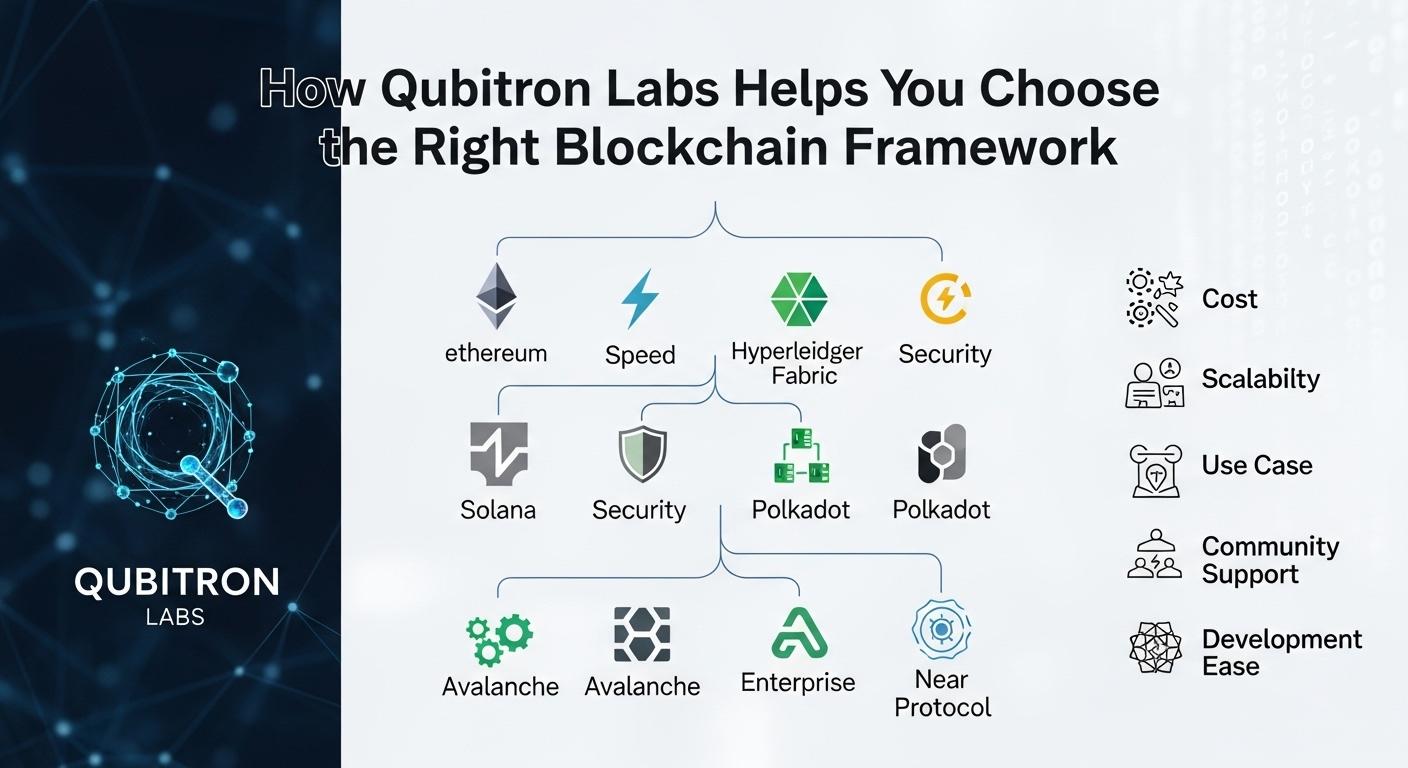
Choosing the right blockchain development framework starts with understanding real business needs, not just technology trends. Many enterprises also think about the benefits of outsourcing blockchain development. Working with an experienced team can save time, reduce costs, and help avoid common mistakes when selecting a framework.
Qubitron Labs helps companies evaluate whether a public, private, or consortium blockchain framework is the best fit. We focus on scalability, compliance, and long-term business value. After selecting the right framework, we support you with custom development, system integration, and enterprise-level deployment.
It is also important to choose the right blockchain development partner. Key factors include technical expertise, strong security practices, and reliable ongoing support. By following this approach, businesses can build blockchain solutions that are secure, scalable, and ready to grow with future needs.
FAQs About Blockchain Development Frameworks
1. Why do businesses need blockchain frameworks instead of building from scratch?
Blockchain frameworks provide ready-made tools and structures. This helps businesses save time, reduce development costs, and avoid technical risks compared to building everything from the beginning.
2. Can a company use more than one blockchain framework in a single project?
Yes, some enterprises use multiple frameworks together. For example, one framework can handle internal operations, while another manages public-facing applications or integrations.
3. Are blockchain frameworks suitable for small businesses or only large enterprises?
Blockchain frameworks can be used by both small and large businesses. Small companies often choose simpler frameworks, while large enterprises prefer advanced frameworks with higher control and security.
4. How long does it take to build a blockchain solution using a framework?
The timeline depends on project complexity, features, and integration needs. Simple solutions may take a few weeks, while enterprise-level systems can take several months.
5. Do blockchain frameworks support integration with existing software systems?
Most modern blockchain frameworks support APIs and integration tools. This makes it easier to connect blockchain solutions with ERP systems, databases, and other business applications.
6. What are the risks of choosing the wrong blockchain framework?
Choosing the wrong framework can lead to scalability issues, higher costs, security risks, and limited flexibility in the future. That’s why proper evaluation is important before selection.
7. How often do blockchain frameworks get updated?
Many frameworks release regular updates to improve security, performance, and features. Enterprises should plan for ongoing maintenance and upgrades when using blockchain technology.
8. Is technical expertise required to manage blockchain frameworks after deployment?
Yes, basic technical knowledge is required for maintenance and monitoring. However, enterprises can outsource support and management to blockchain development companies.
9. Can blockchain frameworks be customized for specific industries?
Yes, blockchain frameworks can be tailored for industries like finance, healthcare, supply chain, and government. Customization helps meet industry-specific rules and requirements.
10. What is the future of blockchain frameworks in enterprises?
Blockchain frameworks are expected to become more scalable, secure, and easy to use. Enterprises will increasingly adopt them for automation, data security, and digital transformation.