
What Is AI and Machine Learning? Complete Beginner Guide
Artificial Intelligence (AI) and Machine Learning (ML) are changing how technology works in our daily lives. From search engines and social media feeds to smart assistants and online shopping suggestions, these technologies are working quietly in the background.
AI focuses on creating intelligent machines that can think, learn, and make decisions like humans. Machine Learning is a key part of AI that allows systems to learn from data and improve automatically without manual programming. Together, AI and ML help computers understand patterns, solve problems, and deliver smarter results.
This complete guide will explain what AI is, how machine learning works, and why these technologies are important today, using simple language and real-world examples.
What Is Artificial Intelligence (AI)?
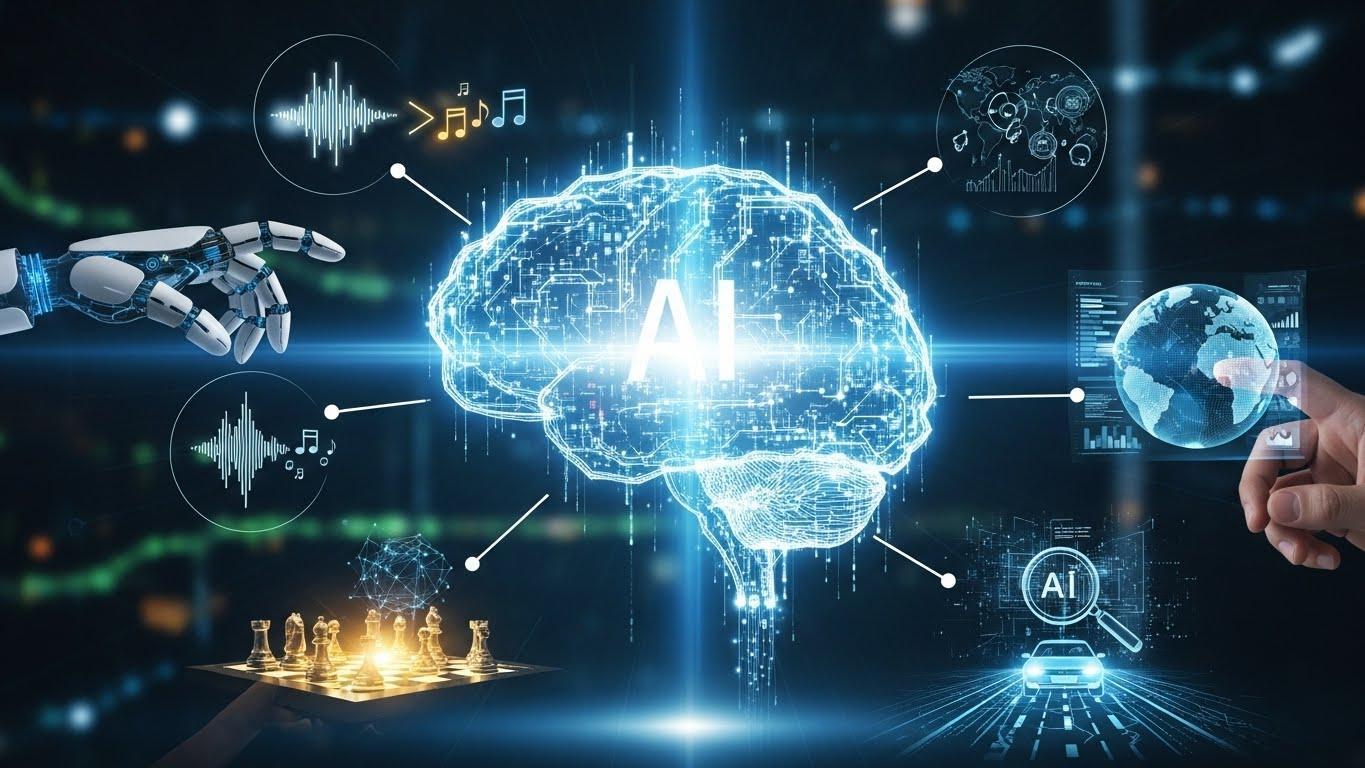
Artificial Intelligence (AI) is a branch of computer science that focuses on creating machines capable of performing tasks that usually require human intelligence. These tasks include learning, reasoning, problem-solving, decision-making, and understanding language.
In simple terms, AI allows computers and software systems to think and act intelligently. Instead of just following fixed instructions, AI systems can analyze information, recognize patterns, and make decisions based on data.
Common examples of artificial intelligence include voice assistants, face recognition systems, recommendation engines, chatbots, and smart navigation apps. All these systems use AI technology to deliver faster, more accurate, and more personalized results.
AI does not mean robots only. It also includes software-based intelligence that works behind the scenes to improve digital experiences.
What Is Machine Learning (ML)?
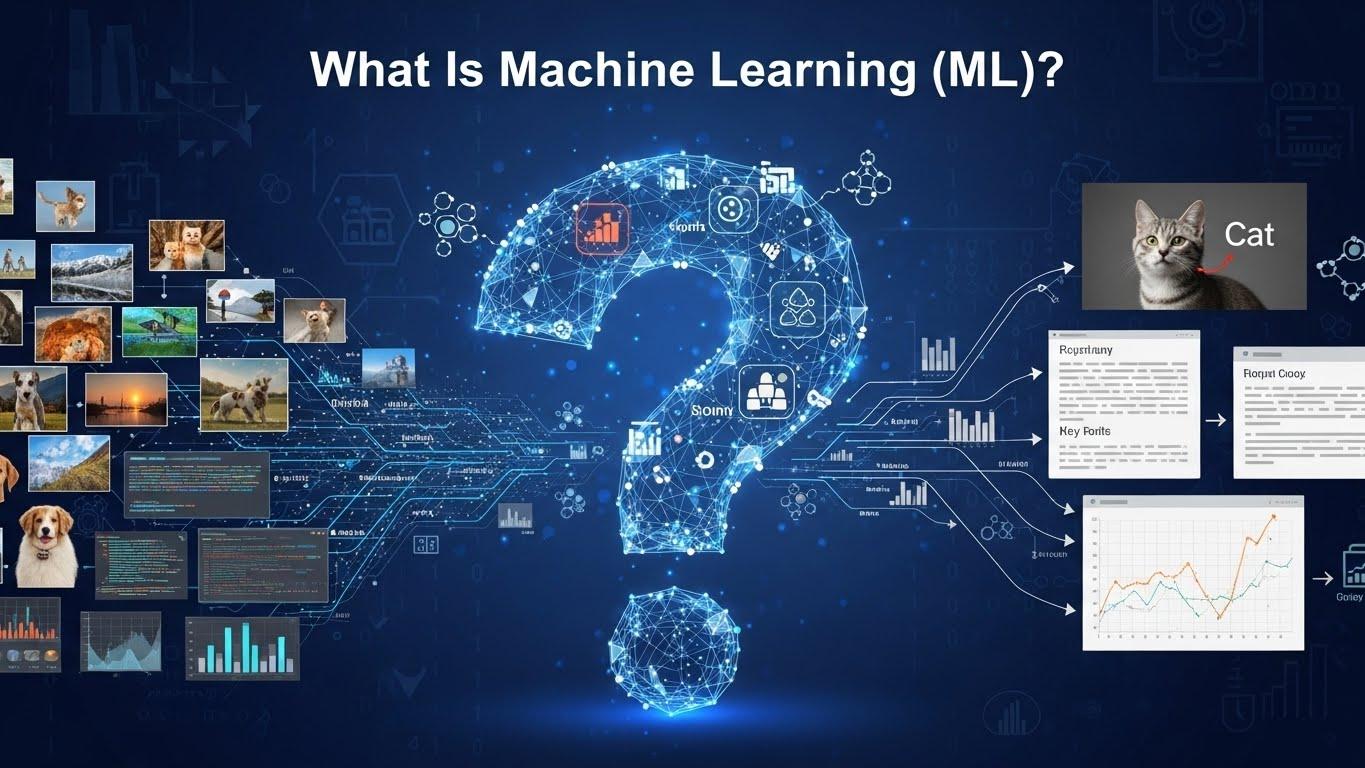
Machine Learning (ML) is a subset of Artificial Intelligence that enables computers to learn from data and improve their performance over time without being explicitly programmed. Instead of relying on fixed rules, machine learning algorithms analyze data patterns and make predictions or decisions on their own.
In traditional programming, developers write exact instructions for every task. In machine learning, the system learns by experience. The more data it receives, the more accurate and efficient it becomes. This is why ML is widely used in data-driven applications.
Examples of machine learning include spam email filtering, product recommendations, fraud detection, and image recognition. These systems continuously learn from new data, making them smarter with time.
In short, machine learning is the engine that powers most modern AI applications.
Difference Between Artificial Intelligence (AI) and Machine Learning (ML)
| Aspect | Artificial Intelligence (AI) | Machine Learning (ML) |
|---|---|---|
| Definition | AI is the broader concept of creating machines that can perform tasks requiring human intelligence | ML is a subset of AI that allows machines to learn from data |
| Scope | Wider scope that includes reasoning, decision-making, and problem-solving | Narrower scope focused mainly on learning patterns from data |
| Goal | To build intelligent systems that act like humans | To improve accuracy and performance using experience |
| Dependency on Data | Can work with or without large datasets | Highly dependent on data for learning and improvement |
| Programming Style | Can be rule-based or data-driven | Mostly data-driven, not rule-based |
| Examples | Chatbots, virtual assistants, expert systems | Spam filters, recommendation systems, price prediction |
| Relationship | AI is the main concept | ML is one of the techniques used in AI |
How Machine Learning Works
Machine learning works by teaching computers to identify patterns in data and use those patterns to make decisions or predictions. Instead of being programmed with fixed rules, the system learns from experience.
The process usually starts with data collection. This data can be derived from user behavior, images, text, transactions, or sensor readings. Once collected, the data is cleaned and organized so the machine learning model can understand it properly.
Next, a machine learning algorithm is trained using this data. During training, the model learns relationships and patterns within the data. After training, the model is tested to assess its accuracy in making predictions on new data.
Finally, the trained model is deployed in real-world applications. As more data is added over time, the system continues to learn and improve, making machine learning highly adaptive and effective.
Types of Machine Learning
Machine learning can be divided into different types based on how the system learns from data. Each type is used for specific kinds of problems and applications.
Supervised Learning
Supervised learning uses labeled data, where the correct output is already known. The model learns by comparing its predictions with the actual results and improving over time. This type of learning is commonly used in spam detection, image classification, and price prediction.
Unsupervised Learning
Unsupervised learning works with unlabeled data. The system does not know the correct output in advance and instead discovers hidden patterns or groupings in the data. It is often used for customer segmentation, data clustering, and market analysis.
Reinforcement Learning
Reinforcement learning is based on rewards and penalties. The model learns by interacting with its environment and improves its actions to achieve the best possible outcome. This type of learning is widely used in robotics, game AI, and self-driving vehicles.
Key Technologies Related to AI and Machine Learning
Artificial Intelligence and Machine Learning rely on several advanced technologies to function effectively. These technologies help machines process complex data and perform intelligent tasks.
Deep Learning is a powerful technique that uses neural networks to analyze large and complex datasets. It is widely used in image recognition, speech processing, and autonomous systems.
Natural Language Processing (NLP) enables machines to understand, interpret, and respond to human language. Applications include chatbots, voice assistants, sentiment analysis, and language translation.
Computer Vision allows machines to interpret and analyze visual information from images and videos. It is used in facial recognition, medical imaging, and security systems.
Speech Recognition technology helps machines understand spoken language, making voice-based interaction possible in smart devices and virtual assistants.
Together, these technologies form the foundation of modern AI-powered systems.
Real-World Applications of AI and Machine Learning
Artificial Intelligence and Machine Learning are widely used across different industries to solve real-world problems and improve efficiency. These technologies are no longer limited to research labs and are now part of everyday life.
In digital platforms, AI is used in search engines and recommendation systems to show relevant results and personalized content. Social media, streaming platforms, and e-commerce websites rely on machine learning to understand user behavior.
In healthcare, AI helps in disease prediction, medical imaging analysis, and patient monitoring. In the finance sector, machine learning is used for fraud detection, credit scoring, and risk analysis.
AI and ML also play an important role in autonomous vehicles, smart traffic systems, customer support chatbots, and business process automation. These applications show how AI-driven solutions are transforming industries.
Benefits of AI and Machine Learning
Artificial Intelligence and Machine Learning offer many benefits for individuals, businesses, and organizations. One of the biggest advantages is automation. AI systems can handle repetitive tasks efficiently, saving time and reducing human effort.
Machine learning helps improve accuracy by analyzing large datasets and identifying patterns that humans might miss. This leads to better predictions, smarter decisions, and more reliable outcomes.
Another major benefit is personalization. AI-powered systems can tailor content, recommendations, and services based on user preferences and behavior. This improves user experience across digital platforms.
Overall, AI and ML help increase productivity, reduce errors, and drive innovation in various fields.
Challenges and Limitations of AI and Machine Learning
Despite their advantages, Artificial Intelligence and Machine Learning also face several challenges. One major issue is data quality. Machine learning models depend heavily on data, and poor or biased data can lead to inaccurate results.
Another challenge is data privacy and security. AI systems often process large amounts of personal information, which raises concerns about misuse and data protection.
Lack of transparency is also a limitation. Many AI models act like “black boxes,” making it difficult to understand how decisions are made. In addition, developing and maintaining AI systems can be costly and require skilled professionals.
Addressing these challenges is important to ensure the responsible and ethical use of AI technologies.
Tools and Languages Used in AI and Machine Learning
To build Artificial Intelligence and Machine Learning systems, developers use specific programming languages and tools. Among them, Python is the most popular because it is easy to learn and has strong community support.
Python offers powerful libraries such as TensorFlow, PyTorch, and Scikit-learn, which help in building and training machine learning models. Other languages like R and Java are also used, especially for data analysis and enterprise-level applications.
In addition to programming languages, cloud platforms and AI frameworks play a key role in developing and deploying AI solutions. These tools make it easier to manage large datasets and scale machine learning applications efficiently.
How to Start Learning AI and Machine Learning
Starting a journey in Artificial Intelligence and Machine Learning does not require advanced knowledge at the beginning. Beginners should first focus on understanding basic programming concepts and data handling.
Learning Python is a good starting point, as it is widely used in AI and ML projects. Along with programming, basic knowledge of mathematics, especially statistics and probability, can be helpful for understanding how machine learning models work.
Practical learning is very important. Working on small projects, exploring real datasets, and following structured online courses can help build confidence. Step-by-step learning and consistent practice make AI and machine learning easier to understand over time.
Future of AI and Machine Learning
The future of Artificial Intelligence and Machine Learning is expected to be more advanced and impactful. As computing power increases and more data becomes available, AI systems will become faster, smarter, and more accurate.
Emerging trends like generative AI, large language models, and intelligent automation are already changing how technology interacts with humans. These advancements will influence industries such as healthcare, education, finance, and transportation.
At the same time, there will be a stronger focus on ethical AI, data privacy, and responsible development. The future of AI and machine learning is not just about innovation, but also about creating technology that benefits society as a whole.
Conclusion
Artificial Intelligence and Machine Learning have become essential technologies in today’s digital world. From simple recommendations to complex decision-making systems, AI and ML are transforming how technology works across industries.
Understanding the basics of AI, machine learning, their differences, applications, benefits, and challenges helps individuals and businesses make informed decisions. As these technologies continue to evolve, learning about them opens new opportunities for innovation and growth.
With the right knowledge and skills, anyone can begin exploring AI and machine learning and be part of the future of technology.